
Ask someone about their cancer risk and you’ll often get a pause before an answer. Many assume they’re probably “average.” Others admit they’re unsure. Some know cancer runs in their family but don’t know what that history actually means for them.
This uncertainty isn’t rare, it’s the norm. And early findings from the Previvor Edge brief cancer risk assessment are beginning to put numbers behind that reality.
The truth is, you can’t manage what you don’t understand. Knowing your cancer risk is the first and most critical step to taking control of it. When you understand your personal risk, you can make informed decisions about screening, prevention, and lifestyle changes that may help reduce it. Awareness isn’t about fear; it’s about giving yourself the power to act early and proactively.
The Moment People Realize They Don’t Know
More than 300 people have completed our risk assessment in just a few days, which takes about 90 seconds from start to finish.
.png)
Most people aren’t confidently wrong. They’re uncertain.
“Average Risk” Usually Means “I Haven’t Looked Closely”
Most people don’t realize that “average risk” still means about 40% of individuals will develop cancer in their lifetime. And early analysis shows that only a small fraction of people truly fall into a low or average risk category—meaning they have no clinical history, family history, genetic markers, lifestyle behaviors, or environmental exposures that increase their risk for specific cancers.
The majority, however, do have indicators of elevated risk. Many show potential inherited or high-risk clinical factors, while others are flagged for increased risk tied to lifestyle or environmental influences. Still others fall into an uncertain category, where incomplete information makes it difficult to fully assess risk—highlighting just how many people may be at higher risk than they realize.
This doesn’t mean most people are destined for cancer. It means many people are carrying risk factors they don’t recognize or don’t know how to interpret—and therefore are not equipped to act.
Cancer risk rarely announces itself clearly. It accumulates quietly—through family history that’s never fully discussed, clinical factors that feel unrelated, or lifestyle patterns that seem normal because they’re common. And when we know about these factors, guidelines exist to help us screen differently and take steps to reduce risk altogether.
Family History: Known, Unknown, or Half-Told
One of the clearest examples of ambiguity in cancer risk is family history.
Most participants report at least one family member with a cancer diagnosis and a meaningful number aren’t sure about their family history at all. Not knowing doesn’t mean nothing is there. It means pieces of the story are missing.
Cancer risk is often framed as a yes-or-no question: “Does it run in your family?” But real life is messier. Risk is shaped by who was affected, what type of cancer, how many relatives, how closely related, and how young they were at diagnosis. Patterns often only emerge when someone helps you look at the full picture.
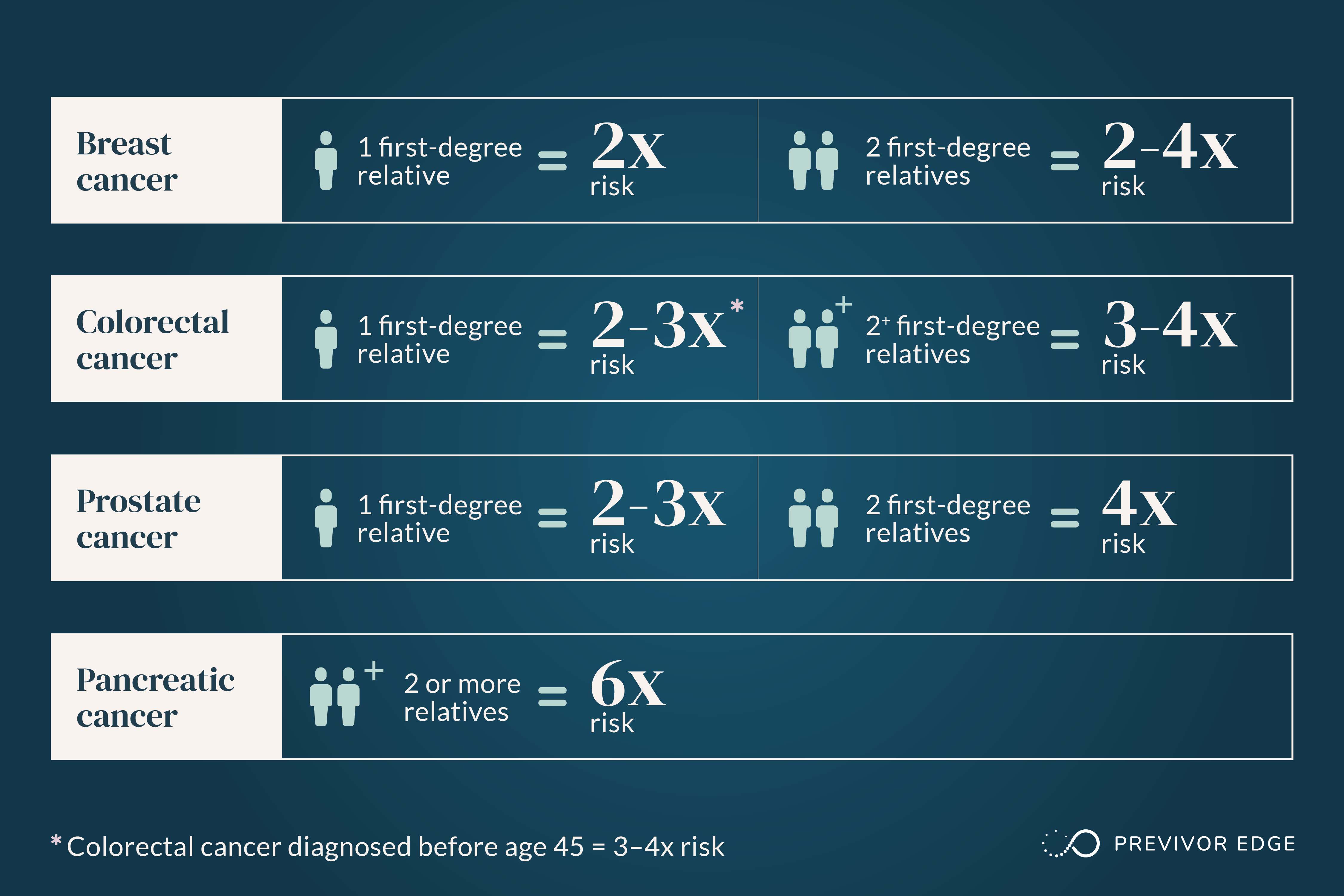
And family history matters. Family history doesn’t determine whether someone will get cancer, but it can meaningfully increase risk and change when and how someone should be screened.
This is relevant across many cancers including, but not limited to, Breast cancer, Colorectal cancer, Prostate cancer, Pancreatic cancer, and Ovarian cancer.
Lifestyle Risk Feels Invisible Because It’s Familiar
Lifestyle factors tell a similar story.
Most participants reported behaviors that fall somewhere in the middle—not extreme, not perfect. Some exercise. Some don’t. Diets are mixed. Alcohol is occasional. Smoking is rare for most.
Individually, these choices feel unremarkable. Collectively, they matter.
What the early data suggests isn’t that people are reckless—it’s that risk often hides within what feels normal. Without the right context, it’s difficult to understand which factors add up, which ones don’t, and where the real thresholds lie when it comes to modifiable lifestyle risks.
The Real Finding: Risk Confusion Is Widespread
The most important early insight from the Previvor Edge assessment isn’t a specific percentage or category.
It’s this: most people don’t have a clear, confident understanding of their personal cancer risk, which means they are not equipped to take the best steps to prevent and detect cancer.
They’re not ignoring the issue. They’re navigating it with incomplete information, outdated assumptions, and a system that isn’t designed to connect the dots in a multidisciplinary way, and often waits until something goes wrong before offering clarity.
Understanding risk isn’t about predicting the future. It’s about replacing uncertainty with awareness so you can act. Given how common cancer is—and how nuanced individual risk can be–investigating that risk and understanding the tools available is the only way we’re going to finally bend the curve on cancer.
You can take our 90-second risk assessment survey here.